The Best Cheap Car Dash Cams: 5 Budget Picks Compared
Five real budget dash cams for cars compared on resolution, night vision, GPS and coverage, from a 4K value king to an ultra cheap 70mai.


A dash cam pays for itself the first time someone brake-checks you, backs into your bumper or disputes who ran the light. The good news is that the budget end of the market has matured: real 4K, GPS logging and usable night vision now cost what bare-bones 1080p cameras did a few years ago. The bad news is that Amazon is flooded with no-name cameras that overheat, corrupt cards or lose support within a year. This guide compares five budget dash cams from brands with real track records: the 4K ROVE R2-4K, the dual-channel REDTIGER F7NP, the rock-bottom 70mai M310, the ultracompact Garmin Dash Cam Mini 3 and the night-vision-focused VIOFO A119 Mini 2. We compared them on resolution and plate capture, night performance, GPS, parking mode requirements and what actually comes in the box, so you know exactly which corner each one cuts.
Table of contents
- Quick picks
- Field of view compared
- Comparison table
- Best Overall: ROVE R2-4K Dash Cam
- Best Budget Front and Rear: REDTIGER F7NP 4K Dash Cam Front and Rear
- Best Ultra Budget: 70mai Dash Cam M310
- Best Compact: Garmin Dash Cam Mini 3
- Best for Night Driving: VIOFO A119 Mini 2 Dash Cam
- How we chose
- What to consider before buying
- Resolution and plate capture
- Night performance
- Parking mode and power
- Final recommendation
- FAQ
Quick picks
Every pick wins a specific use case. Jump to the full review before you buy.
-
Best Overall
ROVE R2-4K Dash Cam
The R2-4K delivers real 4K recording, built-in GPS and WiFi at a price most single-channel 1080p cameras charged a few years ago, backed by one of the largest review histories in the category.
-
Best Budget Front and Rear
REDTIGER F7NP 4K Dash Cam Front and Rear
The F7NP is the cheapest credible way to cover both ends of your car, pairing a 4K front camera and 1080p rear unit with GPS and a memory card already in the box.
-
Best Ultra Budget
70mai Dash Cam M310
The M310 is the cheapest camera in this guide from a brand with a real track record, recording sharp-enough 1296p footage for roughly the cost of a tank of gas.
-
Best Compact
Garmin Dash Cam Mini 3
The Mini 3 is a car-key-sized camera that disappears behind the mirror completely, with a built-in polarizer and Garmin's polished app making it the most refined tiny dash cam you can buy.
-
Best for Night Driving
VIOFO A119 Mini 2 Dash Cam
The A119 Mini 2 pairs a Sony STARVIS 2 sensor with 2K 60fps recording, giving it the best low-light plate capture of any camera near its price.



Compare every pick
| Product | Award | Max resolution | Channels | Gps | Parking mode | Storage support | Best for | Where to buy |
|---|---|---|---|---|---|---|---|---|
| ROVE R2-4K Dash Cam | Best Overall | 4K 2160p front only | 1 (front) | Built-in | Motion detection, hardwire kit sold separately | Up to 512GB microSD, not included | Drivers who want the sharpest possible footage and GPS evidence for the least money and can live with front-only coverage. | Check price for ROVE R2-4K Dash Cam at Amazon (affiliate link) |
| REDTIGER F7NP 4K Dash Cam Front and Rear | Best Budget Front and Rear | 4K front + 1080p rear | 2 (front and rear) | Built-in | 24-hour, hardwire kit required | Up to 256GB microSD, card included | Commuters and city drivers who want both ends of the car recorded for the least total money and do not mind an hour of cable routing. | Check price for REDTIGER F7NP 4K Dash Cam Front and Rear at Amazon (affiliate link) |
| 70mai Dash Cam M310 | Best Ultra Budget | 1296p front only | 1 (front) | Not included | Basic surveillance, hardwire kit required | Up to 128GB microSD, not included | Anyone who wants basic accident evidence for the absolute minimum spend, or a second camera for a spouse's or teen's car. | Check price for 70mai Dash Cam M310 at Amazon (affiliate link) |
| Garmin Dash Cam Mini 3 | Best Compact | 1080p front only | 1 (front) | Via Garmin Drive app | Requires constant power accessory | Up to 512GB microSD, not included | Drivers who prioritize a completely clean windshield and a frustration-free app over raw image quality. | Check price for Garmin Dash Cam Mini 3 at Amazon (affiliate link) |
| VIOFO A119 Mini 2 Dash Cam | Best for Night Driving | 2K 1440p at 60fps front only | 1 (front) | Built-in | 24-hour buffered, hardwire kit required | Up to 512GB microSD, not included | Drivers who do a lot of dawn, dusk or night driving and want the best chance of a readable plate in bad light. | Check price for VIOFO A119 Mini 2 Dash Cam at Amazon (affiliate link) |
Swipe sideways to compare every column.
Best Overall
ROVE R2-4K Dash Cam
by ROVE

The R2-4K delivers real 4K recording, built-in GPS and WiFi at a price most single-channel 1080p cameras charged a few years ago, backed by one of the largest review histories in the category.
What we like
- True 4K 2160p front recording captures plates at distances where 1080p budget cams turn to mush
- Built-in GPS logs speed and location for insurance disputes without an add-on module
- WiFi 6 transfers clips to your phone quickly, so pulling footage does not mean removing the card
- Nearly 40,000 aggregated Amazon ratings give it the deepest reliability track record of any budget pick
What we don't
- Front-only coverage, so rear-end collisions are not recorded without buying the separate Dual version
- No memory card in the box, which adds a required extra purchase before first use
- Parking mode needs the separately sold hardwire kit, pushing the true cost up for anyone who wants monitoring while parked
| Max resolution | 4K 2160p front only |
|---|---|
| Channels | 1 (front) |
| Gps | Built-in |
| Parking mode | Motion detection, hardwire kit sold separately |
| Storage support | Up to 512GB microSD, not included |
| Install difficulty | Easy |
| Price bracket | $$ |
The ROVE R2-4K is the default answer to the budget dash cam question, and it earned that position honestly. It records genuine 4K 2160p video at a price where most competitors still sell interpolated 1080p, and it does so with a track record of nearly 40,000 aggregated Amazon ratings holding a 4.3 average. In a category flooded with no-name brands that appear and vanish within a year, that history is the strongest reliability signal you can get without a lab.
What it solves is the evidence problem. The reason to own a dash cam is proving what happened, and that usually comes down to reading a license plate. The R2-4K’s 8MP sensor resolves plates at distances where the 1080p 70mai M310 and Garmin Mini 3 in this guide record only a colored rectangle. Built-in GPS stamps speed and location onto the file, which matters when an insurer questions your account.
Its biggest limitation is coverage. This is a front-only camera, and rear-end collisions are the most common accident type. If that bothers you, the REDTIGER F7NP adds a rear channel for similar money, though its front sensor is a step behind in fine detail. The R2-4K also ships without a memory card, and parking mode requires ROVE’s separate hardwire kit, so budget another purchase or two.
Buy the R2-4K if you want one camera that does the core job, plate-readable footage with GPS proof, better than anything near its price. Pick the F7NP if two channels beat maximum front detail for you, or the VIOFO A119 Mini 2 if night performance is your priority. This is a research-based recommendation built from specs and aggregated owner reviews, not our own road testing.
Research-based pick: this recommendation is based on product data, owner feedback and comparison with products we have tested, not on direct hands-on testing.
Buy it if: Drivers who want the sharpest possible footage and GPS evidence for the least money and can live with front-only coverage.
Skip it if: You want rear coverage in the box, since the REDTIGER F7NP covers both ends of the car for similar money.
Best Budget Front and Rear
REDTIGER F7NP 4K Dash Cam Front and Rear
by REDTIGER
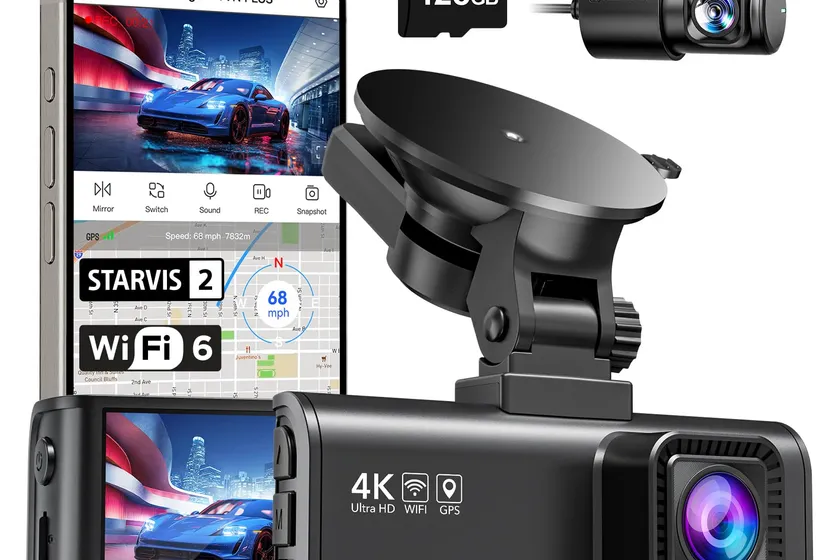
The F7NP is the cheapest credible way to cover both ends of your car, pairing a 4K front camera and 1080p rear unit with GPS and a memory card already in the box.
What we like
- Covers front and rear for the price most brands charge for a single-channel camera
- 4K front plus 1080p rear captures the rear-end collisions that front-only picks miss entirely
- Memory card included, so it records on day one with no extra purchases
- Built-in GPS and 5.8GHz WiFi match features from cameras costing considerably more
What we don't
- Routing the rear camera cable along the headliner and hatch makes this the most involved install in this guide
- Night footage from both sensors trails the STARVIS 2 equipped VIOFO A119 Mini 2, especially for plates under streetlights
- 24-hour parking mode requires the separately sold hardwire kit
| Max resolution | 4K front + 1080p rear |
|---|---|
| Channels | 2 (front and rear) |
| Gps | Built-in |
| Parking mode | 24-hour, hardwire kit required |
| Storage support | Up to 256GB microSD, card included |
| Install difficulty | Moderate |
| Price bracket | $$ |
The REDTIGER F7NP attacks the budget dash cam problem from the coverage angle. Instead of spending its price budget on one exceptional sensor, it splits the money across two cameras: a 4K front unit and a 1080p rear unit, plus GPS, 5.8GHz WiFi and a memory card in the box. Over 25,000 aggregated Amazon ratings suggest the formula holds up in daily use.
What it solves is the most common gap in cheap dash cam setups. Rear-end collisions are the accident you are statistically most likely to be in, and every other pick in this guide simply does not see them. With the F7NP, a brake-check or a distracted driver behind you is on file in 1080p, with GPS speed data proving you were not the one driving erratically.
Its biggest limitation is the install. The rear camera connects by a long cable that must be tucked along the headliner, down the pillar trim and to the rear glass. Owner feedback says it is an hour of patient work rather than a hard job, but it is real effort compared to sticking the ROVE R2-4K to the windshield. Fine night detail also trails the VIOFO A119 Mini 2, whose newer STARVIS 2 sensor reads plates in conditions where the F7NP softens.
Buy the F7NP if full coverage is your priority and the budget is fixed. Choose the R2-4K for maximum front detail with a simpler setup, or the 70mai M310 if even this price is more than you want to spend. As with every pick here, this recommendation comes from spec research and aggregated owner reviews rather than hands-on testing.
Research-based pick: this recommendation is based on product data, owner feedback and comparison with products we have tested, not on direct hands-on testing.
Buy it if: Commuters and city drivers who want both ends of the car recorded for the least total money and do not mind an hour of cable routing.
Skip it if: You want the simplest possible setup or the best night footage, where the ROVE R2-4K and VIOFO A119 Mini 2 respectively win.
Best Ultra Budget
70mai Dash Cam M310
by 70mai

The M310 is the cheapest camera in this guide from a brand with a real track record, recording sharp-enough 1296p footage for roughly the cost of a tank of gas.
What we like
- Costs less than half of most picks in this guide, low enough to put one in a second car or a teen driver's car
- 1296p resolution is a meaningful step above the 1080p sensors common at this price
- 70mai is an established Xiaomi-ecosystem brand, not a disposable no-name label
- Compact wedge shape hides behind the mirror better than screen-based budget cams
What we don't
- No GPS, so footage carries no speed or location data for insurance disputes
- 130 degree lens is the narrowest here and can miss action at the edges of wide intersections
- Capped at 128GB storage and 2.4GHz WiFi, so clip transfers are slow and recording history is shorter
| Max resolution | 1296p front only |
|---|---|
| Channels | 1 (front) |
| Gps | Not included |
| Parking mode | Basic surveillance, hardwire kit required |
| Storage support | Up to 128GB microSD, not included |
| Install difficulty | Easy |
| Price bracket | $ |
The 70mai M310 answers a different question than the rest of this list: not “which cheap dash cam is best” but “how little can I spend and still get something trustworthy.” At roughly half the price of the ROVE R2-4K, it is the cheapest camera here that comes from a brand with millions of units in the field rather than a label invented last quarter.
What you get for that money is genuinely useful. The 1296p sensor is a step above the 1080p that dominates the bargain bin, enough to read plates at close range in daylight, which is where most parking lot disputes and low-speed collisions happen. The wedge-shaped body tucks behind a rearview mirror, the app works over WiFi, and loop recording and the G-sensor handle incident locking automatically.
The compromises are real, though. There is no GPS, so your footage proves what happened but not how fast you were going or where, which weakens it in some insurance arguments. The 130 degree lens is the narrowest in this guide and can clip a car entering from the far edge of a wide intersection. Storage tops out at 128GB, and night footage is serviceable rather than strong; the VIOFO A119 Mini 2 is in a different league after dark.
Buy the M310 as a first dash cam on a strict budget, or as the camera for the household’s second car. If you can stretch to the R2-4K, the jump to 4K and GPS is the single best upgrade in this guide. This is a research-based pick from specs and aggregated owner feedback, not hands-on testing.
Research-based pick: this recommendation is based on product data, owner feedback and comparison with products we have tested, not on direct hands-on testing.
Buy it if: Anyone who wants basic accident evidence for the absolute minimum spend, or a second camera for a spouse's or teen's car.
Skip it if: You need GPS speed data or plate detail at distance, where the ROVE R2-4K is worth the extra money.
Best Compact
Garmin Dash Cam Mini 3
by Garmin

The Mini 3 is a car-key-sized camera that disappears behind the mirror completely, with a built-in polarizer and Garmin's polished app making it the most refined tiny dash cam you can buy.
What we like
- Ultracompact body is invisible behind most rearview mirrors, ideal for lease cars and clean interiors
- Built-in Clarity polarizer cuts dashboard reflections that wash out footage on cheaper cameras
- Voice control works reliably, useful since there is no screen to tap
- Garmin's app and firmware support are the most polished of any brand in this guide
What we don't
- 1080p resolution reads fewer plates at distance than the 4K and 2K picks here
- No screen and no built-in GPS, so setup, playback and location data all depend on your phone
- Highest price per pixel in this guide, and parking monitoring needs a constant power accessory on top
| Max resolution | 1080p front only |
|---|---|
| Channels | 1 (front) |
| Gps | Via Garmin Drive app |
| Parking mode | Requires constant power accessory |
| Storage support | Up to 512GB microSD, not included |
| Install difficulty | Easy |
| Price bracket | $$$ |
The Garmin Dash Cam Mini 3 is the pick for people whose main objection to dash cams is the dash cam itself. It is about the size of a car key, sticks behind the rearview mirror where neither you nor anyone outside can see it, and has no screen, no dangling GPS mount and no visual clutter at all.
What it solves is the discretion and hassle problem. A visible camera can invite break-ins and annoys drivers who like a clean cabin. The Mini 3 removes the camera from view, and Garmin’s app handles everything a screen would. The built-in Clarity polarizer is a quietly important feature: dashboard reflections are one of the most common complaints about budget cameras, and a factory-fitted polarizer addresses it in a way no other pick here matches. Owner feedback consistently rates Garmin firmware and app stability well above the budget-brand average.
The tradeoff is raw capability per dollar. You pay more than the ROVE R2-4K charges for 4K, and you get 1080p. Plate capture at distance is the weakest of this group alongside the 70mai M310, there is no built-in GPS, and parked monitoring requires Garmin’s constant power accessory. As pure evidence gathering, the R2-4K and VIOFO A119 Mini 2 are simply better value.
Buy the Mini 3 if invisibility, polish and long-term software support are worth a premium over pixels. Buy the A119 Mini 2 if you want a small camera that also wins on image quality, or the M310 if compact and cheap matters more than refined. This recommendation is research-based, drawn from specs and aggregated owner reviews rather than our own testing.
Research-based pick: this recommendation is based on product data, owner feedback and comparison with products we have tested, not on direct hands-on testing.
Buy it if: Drivers who prioritize a completely clean windshield and a frustration-free app over raw image quality.
Skip it if: You want maximum footage detail for the money, since the ROVE R2-4K records 4K at a similar price.
Best for Night Driving
VIOFO A119 Mini 2 Dash Cam
by VIOFO

The A119 Mini 2 pairs a Sony STARVIS 2 sensor with 2K 60fps recording, giving it the best low-light plate capture of any camera near its price.
What we like
- Sony STARVIS 2 sensor produces the cleanest night footage in this guide, where evidence matters most
- 1440p at 60fps captures fast-moving plates that 30fps cameras blur
- Built-in GPS and 5GHz WiFi at a price where many rivals include neither
- VIOFO's enthusiast reputation means long firmware support and a proven buffered parking mode
What we don't
- Front-only coverage, so it misses rear-end collisions entirely
- No included memory card, and the buffered parking mode requires a separately sold hardwire kit
- Small 1.5 inch screen makes on-camera menu changes fiddly compared to bigger-screen rivals
| Max resolution | 2K 1440p at 60fps front only |
|---|---|
| Channels | 1 (front) |
| Gps | Built-in |
| Parking mode | 24-hour buffered, hardwire kit required |
| Storage support | Up to 512GB microSD, not included |
| Install difficulty | Easy |
| Price bracket | $$$ |
The VIOFO A119 Mini 2 exists because resolution numbers do not tell the whole story. Its 2K 1440p output is lower than the 4K of the ROVE R2-4K and REDTIGER F7NP on paper, but its Sony STARVIS 2 sensor is a newer, more light-sensitive design than what those cameras carry, and it records at 60 frames per second, double the usual rate.
What that combination solves is the hardest evidence scenario: a plate on a moving car at night. Hit-and-runs disproportionately happen in the dark, and this is where cheap 4K sensors fall apart into noise and smear. Aggregated owner footage and community testing consistently show the A119 Mini 2 pulling readable plates under streetlights where similarly priced cameras cannot. The 60fps rate also freezes fast crossing traffic that 30fps cameras render as a blur.
VIOFO is the enthusiast’s brand in this space, and it shows in the details: buffered parking mode that saves the seconds before a trigger event, years of firmware updates, and support for CPL filters. The limitations are the familiar single-channel ones. There is no rear camera, no card in the box, and parking mode needs the hardwire kit. The 1.5 inch screen is also cramped, though most owners manage everything through the excellent app.
Buy the A119 Mini 2 if your commute involves darkness or you want the best evidence quality per dollar in poor light. Pick the R2-4K for daytime detail, or the F7NP if rear coverage outranks night performance. As throughout this guide, this is a research-based pick from specs and aggregated owner reviews, not hands-on testing.
Research-based pick: this recommendation is based on product data, owner feedback and comparison with products we have tested, not on direct hands-on testing.
Buy it if: Drivers who do a lot of dawn, dusk or night driving and want the best chance of a readable plate in bad light.
Skip it if: Most of your driving is daytime, where the ROVE R2-4K's 4K sensor resolves more detail for similar money.
How we chose#
This is a research-based guide, not a hands-on road test. We started from the budget dash cams that owners and enthusiast communities most consistently recommend, then verified every pick against its current Amazon listing: actual recorded resolution rather than marketing labels, whether GPS and a memory card are included, what parking mode really requires, and what large aggregated review histories say about heat tolerance and card corruption.
We only considered brands with an established track record, because the budget dash cam aisle is full of interchangeable labels that disappear before their first firmware update. Every pick here comes from a maker with years of shipping cameras and active support. We then chose across realistic buyer scenarios: an all-around value leader, the cheapest credible two-channel setup, a rock-bottom option, a stealth pick and a night-vision specialist.
What to consider before buying#
Start with coverage. A front camera documents most incidents, but rear-end collisions, the most common accident type, need a rear channel. Only the REDTIGER F7NP covers both ends here; every other pick trades that for a better front camera or smaller body.
Next, decide if you need GPS. Speed and location stamped on the footage strengthens an insurance claim considerably, and it is the first feature ultra-cheap cameras cut. The 70mai M310 and Garmin Mini 3 skip built-in GPS; the other three include it.
Finally, budget for the extras. Four of the five picks ship without a memory card, and every one of them needs a hardwire kit or constant power accessory for parking mode. The sticker price is rarely the full price.
Resolution and plate capture#
The entire value of dash cam footage collapses if you cannot read the other car’s plate. As a working rule, 1080p reads plates within a couple of car lengths in daylight, 1440p stretches that meaningfully, and 4K roughly doubles it. Frame rate matters too: the VIOFO A119 Mini 2’s 60fps freezes crossing traffic that standard 30fps cameras blur. Match the sensor to your risk: city crawling favors width and coverage, highway commuting favors resolution and frame rate.
Night performance#
Most hit-and-runs and parking lot incidents happen in poor light, and this is where budget cameras differ most. Sensor generation beats resolution after dark: the A119 Mini 2’s Sony STARVIS 2 chip produces cleaner night footage than older 4K sensors that dissolve into noise. If your commute includes dawn, dusk or unlit roads, weight night performance above megapixels.
Parking mode and power#
Every camera here can watch your car while parked, but none can do it out of the box. Parking mode needs constant power, which means a hardwire kit tapped into a fuse or, for the Garmin, a constant power accessory. Buffered parking modes, like those on the VIOFO and ROVE, save the seconds before an impact rather than starting recording after it, which is the difference between seeing the hit and seeing the aftermath.
Final recommendation#
Most buyers should get the ROVE R2-4K: real 4K, GPS and a huge reliability record at a budget price. Choose the REDTIGER F7NP if rear coverage matters more than peak front detail, and the VIOFO A119 Mini 2 if you mostly drive at night. The Garmin Dash Cam Mini 3 is the pick when a clean windshield and polished software justify a premium, and the 70mai M310 is the honest answer when the budget is the budget, for a second car or a first camera that still comes from a brand you can trust.
Frequently asked questions
Will a cheap dash cam work in any car?
Yes. Every camera in this guide powers from a standard 12V accessory socket with an included cable and sticks to the windshield with an adhesive or suction mount, so they fit any car, truck or SUV. The only compatibility question is parking mode, which requires a hardwire kit wired to your fuse box, and those kits are universal too.
How long do budget dash cams last?
The camera itself commonly lasts 3 to 5 years. Heat is the main killer, which is why established brands like the five here matter: they use capacitors or heat-rated batteries instead of the cheap cells that swell in no-name cameras. The memory card usually dies first, since dash cams rewrite it constantly. Budget for a new high-endurance card every couple of years.
Do I need to buy anything else besides the camera?
Usually a memory card, since only the REDTIGER F7NP includes one here. Buy a high-endurance card rated for dash cams, not a standard card. If you want recording while parked, every pick also needs a hardwire kit or constant power accessory, typically a 20 to 30 dollar add-on plus 30 minutes at the fuse box.
Is 4K worth it on a cheap dash cam, or is 1080p enough?
Resolution decides whether you can read a license plate, which is the whole point of the footage. 1080p works at close range in daylight, 1440p adds useful margin, and 4K roughly doubles your plate-reading distance. If footage will ever need to identify a hit-and-run driver rather than just show fault, the 4K ROVE R2-4K is the better buy over the 1080p picks.
What is the biggest mistake people make with their first dash cam?
Using a standard microSD card and never checking the camera again. Regular cards fail quietly under constant rewriting, and owners discover the camera stopped recording weeks before the crash they needed it for. Use a high-endurance card, format it in the camera every month or two, and confirm the app still shows fresh clips.
Why do these cameras vary so much in price if they are all budget picks?
You are paying for different strengths. The 70mai M310 is cheapest because it drops GPS and records at 1296p. The ROVE R2-4K and REDTIGER F7NP spend the money on 4K sensors and features. The Garmin Mini 3 charges a premium for its tiny size and polished software, and the VIOFO A119 Mini 2 for its newer Sony STARVIS 2 night sensor.
About the author

Dale Harper Lead Gear Editor
Dale has spent 12 years fitting, comparing and living with truck and SUV accessories across two F-150s and a Tacoma. Every guide on this site is built from manufacturer fit data, owner feedback and direct spec comparison, and research-based picks are always labelled.
Daily driver: 2022 Ford F-150 XLT SuperCrew
- Tonneau covers and bed accessories
- Seat covers and interior protection
- Lift kits and suspension